Thursday, June 26, 2008

Behind the wall in Palestine...


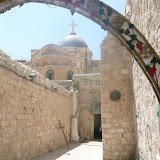
Let me make this clear. I DO NOT LIKE THE WALL BETWEEN ISRAEL AND PALESTINE. Its really frightening because it is huge and is covered in barbed wire and the check points are complicated. My friends and I felt like we were being shoved around like a bunch of cattle, and we were Americans so we received nice treatment! It is also obvious that the wall helped suck a lot of life out of Palestine. Every Arab city I have visited is full of energy and people haggling over goods. Palestine (the areas where I visited which was Bethlehem and Ramallah, the "nicer" areas) was like a ghost town. We didn't see that many people, especially near the wall and it was really quiet. The tourists helped with the noise when we visited the Nativity Church that was built where they believed Jesus was born.

Ramallah was busier, but still depressing. We had dinner at a friend's family house and they were so nice, and the food was amazing! But it was hard to hear that they had problems leaving the country, even for work related matters.

I don't have a lot to say about Palestine because I didn't spend that much time there, but I at least learned a lot about the affects of the occupation and I didn't even get to witness the most oppressed places.

I really hope the conflict between Israel and Palestine gets solved. Its really hard to see people live with fear, hatred, and frustration. I also think that people should be able to leave their country whenever they want (but this problem exists in the majority of 3rd world countries as well). Hmm, this is when I wish that the Miss America's words of world peace would actually come true. Hahaha.


Israel/Palestine

Interesting look on life in Cairo


Thought that this was interesting....and also very true!! I know its not politically correct to copy and paste the article, but blogspot wasn't a share option:(


June 20, 2008
Cairo Journal
With a Word, Egyptians Leave It All to Fate
By MICHAEL SLACKMAN

CAIRO — The McDonald’s here has golden arches, the same golden arches as anywhere else in the world. The food is prepared the same assembly-line way, too. But there is an invisible, or more precisely, divine, element in bringing that burger to the plate that the uninitiated may not be prepared for.

“Inshallah,” or “God willing,” the counterman said as he walked off to see about a burger without onions at the McDonald’s on the Alexandria Desert Road, 30 miles from the center of Cairo.

Egyptians have always been religious, from Pharaonic times to the present. Any guidebook to Egypt alerts tourists to Egyptians’ frequent use of inshallah in discussing future events, a signal of their deep faith and belief that all events occur, or don’t occur, at God’s will. “See you tomorrow,” is almost always followed by a smile and, “inshallah.”

But there has been inshallah creep, to the extreme. It is now attached to the answer for any question, past, present and future. What’s your name, for example, might be answered, “Muhammad, inshallah.”

“I say to them, ‘You are already Muhammad or you are going to be Muhammad?’ ” said Attiat el-Abnoudy, a documentary filmmaker in Cairo.

Inshallah has become the linguistic equivalent of the head scarf on women and the prayer bump, the spot where worshipers press their foreheads into the ground during prayers, on men. It has become a public display of piety and fashion, a symbol of faith and the times. Inshallah has become a reflex, a bit of a linguistic tic that has attached itself to nearly every moment, every question, like the word “like” in English. But it is a powerful reference, intended or not.

Political and social commentators here say its frequent use reflects or fuels, or both, the increasing degree to which people have dressed the routine of daily life up with religious accessories. Will the taxi get me to my destination? Will my sandwich come without onions? What’s my name? It’s always, “God willing.”

“Now inshallah is used in a much broader way than 20 years ago,” said the Egyptian playwright Aly Salem. “We always used to say inshallah in relation to plans we were going to do in the future. Now it is part of the appearance of piety.”

The starting point for inshallah is faith, but just like the increasing popularity of the head scarf and the prayer bump, its new off-the-rack status reflects the rising tide of religion around the region. Observance, if not necessarily piety, is on the rise, as Islam becomes for many the cornerstone of identity. That has put the symbols of Islam at the center of culture, and routine.

“Over the past three decades, the role of religion has been expanded in everything in our lives,”’ said Ghada Shahbendar, a political activist who studied linguistics at American University in Cairo.

Deference to the divine has become a communal reflex, a compulsive habit, like the incessant honking of Egyptian cabdrivers — even when there are no other cars on the street.

Samer Fathi, 40, has a small kiosk that sells chips and cigarettes and phone cards downtown. He was asked for a 100-unit phone card and responded almost absent-mindedly “inshallah,” as he flipped through the stack to find one.

At 19 Ismael Street the elevator door opened.

“Going down?”

“Inshallah,” a passenger replied.

As it has become routine, inshallah has also become a kind of convenience, a useful dodge, a bit of theological bobbing-and-weaving to avoid commitment. No need to say no. If it doesn’t happen, well, God didn’t mean it to happen. Nazly Shahbendar, Ghada’s daughter, said for example if she was invited to a party she did not want to attend, she would never say no.

“I’d say inshallah,” said Ms. Shahbendar who is 24 and anything but a picture of the new religiosity. She is not veiled or shy about talking to men; she smokes in front of her mother.

She also points out that inshallah is not the only religious term to infiltrate the lexicon of routine. The younger Ms. Shahbendar, like many people here, have taken to using the Shahada, the Muslim declaration of belief, as a routine greeting. So instead of “How are you? Fine, and you?” she will say to a friend “There is no God but God,” to which the friend will complete the statement. “And Muhammad is his prophet.”

People now answer the phone that way, too, skipping hello altogether. It would be something like Christians greeting each other with “Christ is risen!” followed by “Christ will come again.” Not just on Sundays, but every day.

“We are a very religious people, Egyptians,” said Mostafa Said, 25, as he told his friend he hoped, inshallah, to have his car turn indicator fixed by next week. “We believe God is responsible for what happens, even to the car.”

But it is not just about faith in the celestial that has people invoking God. It is also, at least for some, a lack of faith in the earthbound rulers who run the place. People here are tired — of the rising prices and the eroding wages, of the traffic, of the corruption, of the sense that it is every man for himself.

“In this place, when something works, or you want something to work, you thank God, because it’s certainly not the government who is going to help you,” said Sherif Issa, 48, a taxi driver in Cairo with a nicotine-stained mustache and a fair size belly. “It’s because everything is going in the wrong direction — who can we look up to except God?”

That Mr. Issa is a Christian is evidence that the use of inshallah is not just a phenomenon of Egypt’s Muslims.

“It doesn’t matter whether you’re a Christian or a Muslim,” he said. “I’m going to take you to your house, arriving there in a decent amount of time is already a miracle. Of course I say inshallah!”

Nadim Audi contributed reporting.

Wednesday, April 16, 2008

Rising prices of food causes a crisis in Egypt


I'm sure that you have already heard this in the news, but if not, : The prices of food has steeply increased throughout the whole world, causing panic. There are already millions of people living below the poverty level and now there will be more. People are protesting and asking their governments for help, but they aren't doing anything. Egypt is one of the countries suffering from the inflated prices. Through word of mouth and facebook, a demonstration was organized. Of course the government heard about it and prepared for the demonstrating by deploying riot and secret police throughout the whole capitol. Many of my Egyptian friends asked me not to go to school (but I had a presentation, and couldn't miss anymore classes) and some classes were canceled at AUC. On my way to school there were riot police stationed all over the main square (Midan tahrir) and my teachers encouraged me to go home quickly after classes. However, nothing happened. I never felt threatened (but it was weird to see soooo many police)and didn't witness any demonstration. I was relieved because I didn't want to be caught in the middle of anything...but also frustrated that the Egyptian people weren't able to fight for their rights to life and ability to eat. But as it turns out, there were demonstrations in a different area and also near Sinai. The following two articles better explain the situation. Also, some Americans were arrested for taking pictures of the riot police. oops, but they were quickly released after a day or two.


Tuesday, April 8, 2008 - Page updated at 12:00 AM
By PAUL SCHEMM

The Associated Press

MAHALLA EL-KOBRA, Egypt — Egyptian police attacked protesters who tore down a billboard of President Hosni Mubarak in a northern city Monday in the second day of violence fueled by anger over low wages and rising prices.

In another sign of dissatisfaction with the U.S.-backed government, the country's most powerful opposition group, the Muslim Brotherhood, said it was reversing a decision to participate in local elections today because of mass arrests of its members in recent months.

Prices of cooking oil, rice and other staples have nearly doubled since the beginning of the year and there are widespread shortages of government-subsidized bread throughout the country of 76 million people. Nearly 40 percent of Egyptians live under the internationally defined poverty line of $2 a day. Complaints that the government is not doing enough to help the poor have turned simmering dissatisfaction with repression and lack of economic opportunity into rare open unrest.

Thousands of demonstrators torched buildings, looted shops and hurled bricks at police in the Nile Delta city of Mahalla el-Kobra on Sunday. Nearly 100 others were arrested elsewhere in protests over economic problems. Thousands skipped work and school and hundreds protested.

Protesters stormed City Hall in Mahalla, burned tires in the streets, smashed chairs through shop windows and ran off with computers. At least two schools were set ablaze and facades of banks were vandalized. The police responded with tear gas and detained more than 500 protesters, according to a report by Al Masry-alyoum, an independent Cairo newspaper.

Protesters, including families of 300 residents and textile workers detained since Sunday, tried to meet with visiting Prosecutor General Abdel Meguid Mahmoud. When they failed, they stoned his motorcade, an Interior Ministry spokesman, who asked not to be identified, said. Mahalla is the center of Egypt's textile industry.

Several hundred young men massed in Mahalla's main square on Monday, throwing rocks at a billboard of Mubarak and slashing it with knives before toppling it.

Riot police charged the group, firing heavy volleys of tear gas, pulling some of the men to the pavement and beating them with batons or fists. Protesters threw stones or canisters of tear gas at the police.

At least 25 people were arrested, and 15 protesters and five policemen were hurt, security officials said on condition of anonymity because they were not authorized to talk to the media.

The government appears worried by the unrest and lifted import duties on some food items last week in an effort to lower prices. It strongly warned citizens against participating in the strikes and demonstrations, which are illegal in Egypt.

The Muslim Brotherhood said Mubarak's administration also had arrested more than 1,000 of its members and potential candidates, detaining 400 after the group announced last month that it would take part in today's municipal elections.

The Brotherhood is a banned organization and its candidates run officially as independents, although their allegiances are generally known.

On Monday, the group urged supporters to boycott municipal polls, saying on its Web site that the elections "have already been fixed before being held."

Brotherhood lawyer Abdel-Moneim Abdel-Maqsoud said the government had disqualified most of the several hundred Brotherhood members who had registered as candidates, and that in the end only 21 members from the group were allowed to run. He said they would withdraw their candidacies.

A security official said around 30 figures believed to be connected to the Brotherhood had been allowed to run. The official spoke on condition of anonymity because he was not authorized to talk to the media.

"We feel we are not competing with a normal party but with a group of corrupt people who are willing to even resort to illegal and unethical means," the Brotherhood said. "The party of corruption and despotism is afraid of any contest."

The United States and international human-rights groups have criticized the Egyptian government's crackdown on the Brotherhood, but Washington has exerted little pressure for reform on Mubarak, one of its staunchest allies in the Middle East.

State Department spokesman Sean McCormack said Monday he hadn't seen reports on Egyptian protesters clashing with security forces but said Washington has "talked to the Egyptian government about the importance of political and economic reform."

"We always encourage countries in the region and around the world to do everything that they possibly can. And is there more to do? Absolutely. There's more to do in Egypt," McCormack said. "But fundamentally, they're going to have to arrive at their own decisions about the pace and the direction of this reform."

The Brotherhood scored surprise victories in 2005 parliament elections that gave it a fifth of the legislature's 454 seats. The local elections had been scheduled to take place in 2006, but were put off for two years, apparently out of fear of more Brotherhood gains.

Word of the strikes and demonstrations spread through social-networking Internet sites and blogs.

"Some students and bloggers waged a campaign on the Facebook Web [site] and gathered more than 70,000 supporters in several groups," said Alaa Alghatrifi, producer of Egypt's "10 PM" talk-show program, which has a following akin to Larry King's. "Some of them decided to go down in the streets to demonstrate, and others made up-to-the-moment coverage using the cellphone cameras and laptops."

The nationwide strike was the first major attempt by opposition groups to turn the past year's labor unrest in Egypt into a wider political protest against the government of President Hosni Mubarak. The strike and riots in the north began two days before key elections for local councils, causing worries in the government, which last week lifted import duties on some food items in an effort to soften economic discontent.

Said activist May Kosba: "We are living in a country that makes strikes, demonstrating and expressing your anger or disagreements in a peaceful way illegal, so people decided to express themselves illegally."

Material from Bloomberg News Service is included in this report.

Copyright © 2008 The Seattle Times Company

This is a good article that portrayed the mood of the demonstration...
http://commentisfree.guardian.co.uk/jack_shenker/2008/04/protests_in_the_smog.html

Thursday, April 10, 2008

Pros and Cons of Modernization

I read an article on Qatar this morning about its rapid modernization. Its a very good read because it talks about how Qatar is able to make a name for itself in the world but at the same time it has also lost a lot of flavor in the older parts of the capital.


http://www.mideasti.org/encounter/modernization-daily-life-qatar

Wednesday, April 9, 2008

YEMEN!!!!


Jessica and I had a 4day weekend because of Mother's Day and to celebrate the birth of the Prophet Mohamed (). In Egypt, not everyone celebrates his birthday. When they do, they buy lots of candy and sugar dolls. It is also another reason for families to gather together. (http://en.wikipedia.org/wiki/Mawlid)
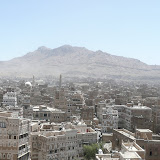
To celebrate the break from school, Jessica and I traveled to Yemen to visit one of my friends from UW. When we first made plans to travel, many of my friends were surprised and tried to persuade me not to go saying that there was nothing to do in Yemen (Heaven forbid we travel to a country with no shopping malls:)) and that the country is uncivilized. Going to Yemen was definitely a culture shock!!! I know I would never be able to live there but I'm really glad I visited it. I like to think of Yemen as a country full of wrinkly old men, breathtaking geography, Qat chewers, and millions and millions of little children who wanted their pictures taken. (you will understand once you see my pictures:)) Even the old men wanted pictures!! The people were really nice, always shouting "hello" and "Welcome to Yemen." The thing that disgusted me the most were the men when they were chewing qat (which was all the time!!) ( ) ( http://www.american.edu/ted/qat.htm ) There isn't a whole lot to do in Yemen and the majority of the people are unemployed, so the men chew qat in the afternoon. I don't really understand it, but from what I witnessed is that the men stuff huge wads of qat leaves in their mouths creating a large bump and then they chew on the leaves for the rest of the day. The men look really weird and it is so difficult to understand them! But I hear that the leaves help reduce hunger...which is why everyone there was deathly skinny!! Qat chewing is a bad habit because not eating is very unhealthy, but at the same time approximately 75% of the population is malnourished and living below the poverty line. So maybe its helpful psychologically. However a friend pointed out that the men spend 60% of the income on qat. hmmm. Where does that leave their children who should grow up with proper healthcare and education? And the women? They are also extremely skinny. But even with this problem, I wouldn't consider Yemen to be uncivilized. It is true that the only regular toilet I found was in my friend's apartment, and most of the buildings we stayed in (in the old city at least) were built shortly before the 12th century!! Also, everyone wears the traditional clothing (the men wear thobes (the white man dress) with a decorative dagger on their belts and the women are covered from head to toe in black). But there was running water, electricity, cars in the streets (I only saw donkeys on farms) and transportation systems. The transportation was my favorite. You could get on random buses that would drive you around town...hahah we even got into and accident!! I feel so stupid because I watched the car hit the bus under my window, and I could have been hurt. oops! oh well!! It wasn't a bad accident and both the bus and car were previously banged up, making it hard to notice the impact of the crash:) We also rode random trucks up the mountain to visit an old Imam's palace (dated around the 1950's, so fairly modern:)). But I don't think the lack of modern dress wear and transportation laws/systems is a reason for Yemen to be uncivilized. They are just living very differently:) I'm just amazed that tradition is still a main value of life, and that the ancient infrastructures are still beautifully decorated, not to mention standing! The government is also working a little harder. It recently created a firearm ban for non-military and non-governmental people in hopes to make the country safer (although I never felt in danger) and to encourage tourism....which would in turn improve the economy in hopes to reduce the percentage of malnourished people. Yemen would never be as strong in tourism as Egypt because it doesn't have as a remarkable history, but its never ending mountains and breathtaking views have a potential for catching a lot of attention.
While I was in Yemen I also visited the Shahara mountains. There is an ancient bridge built about a large ravine that connects two villages. Lets just say getting to that bridge was an adventure!! My friends and I shared a Land Rover and a driver to take us to the mountains. There were several military checkpoints along the way, where we were required to give them copies of our travel permits. But our driver didn't make enough copies. So once we ran out...the driver started telling the guards that we were Syrian, which was definitely convincing with Jessica's red hair. haha oh well, it worked! We also stopped at a village called Amran. The people there were really kind and I've never seen so many children in my life!! And they all wanted their pictures taken!! haha this was the vacation I really wanted...to witness people living totally different than me, and to have kids be really excited to see us and follow us everywhere we went. I just wish I had school supplies to give them:( Anyways, back to the mountains. We drover for what seemed several hours and then reached the base of the mountains. The Land Rovers couldn't drive anymore so we transferred to 4x4's and stood in the bed of the pick ups for 2 hours!! What an experience!! haha there were a few times we swore that our truck wouldn't make it up the mountain because the roads were so steep and weren't always in the best condition. But we made it, and the view was even more breathtaking than the bridge! I was in awe:) Then a bunch of kids showed us around their village ( ) (Out of this rises the Shahara, a huge mountain massif, the highest point being nearly 3,000m (9,840ft) above sea level. This can be climbed by foot or by 4-wheel drive car. Shahara Bridge, built in the 17th century, connects two mountains and can still be crossed by foot.)
( http://www.viewzone.com/y-page31.html )

The village even had schools, a prison, and a court system. I was quite impressed:) The next day we walked down the mountains. I have so much respect for the villagers because walking down the mountain was sooo difficult!! It was really steep and there wasn't always a real path. And of course I had to show off my graceful side by falling and twisting my ankle! Oh well, I made it the rest of the way and the guys who traveled with us helped me walk slowly:) Then after another long car ride, we returned to Sana'a and passed out in my friend's apartment. The next day we explored the city, visited the Imam's palace (which was located on top of a rock, built a little over 50 years ago) and of course we bought souvenirs at the ancient souq (market):)

Yemen was definitely worth visiting and I recommend it to everyone...unless you only travel to go shopping and be pampered in spas...

Here are some random facts about Yemen:
oh I forgot to mention....the traditional food (salta) was really good. It was this spicy, bubbly goo with meat and you dip bread into it. Looks weird, but I would eat it again:)


http://en.wikipedia.org/wiki/Yemen


Next trip...Spring Break!!

I'm going to Syria, Jordan, and Palestine-Israel


Yemen

Saturday, March 1, 2008

What do I think of Egypt so far??

I absolutely love Egypt!! The people are young at heart, friendly, and always willing to help. People consider Egypt to be Al-om al-dunia (mother of the world)...and it really is!! Egypt is never boring because there is always something different to do and the people never sleep. Unfortunately there are so many poor people in Egypt...and the only way to fully enjoy her beauty is to have money. People do enjoy themselves with cheap activities...such as hanging out by the Nile river or drinking tea (if you don't drink tea in Egypt....there is something seriously wrong with you:))...but as a foreigner I feel like I enjoy Egypt a lot more. Egyptians are thrilled when they learn that I love Egypt...but they can never understand why. But I'm naive to the problems of Egypt. I can afford a maid to clean my apartment, I have someone clean my clothes, I can take any form of transportation I want and I have friends who are members of country clubs. So I can relax somewhere clean and fun. I can afford to eat and most importantly I can leave whenever I want. It's really sad to know that most of my Egyptian friends that I've made here won't be able to visit me....because it is very difficult/almost impossible to obtain a visa. And they are the best group of friends I have ever had. The government has a lot of money because Egypt is actually a rich country with its ancient history, tourism, and agriculture. But Egypt is a desert so people are confined to living close to the Nile river...and the population is increasing....making free space literally unavailable. And the government either keeps all the money or uses it to improve tourists sites. They don't care that police officers in the street only make 70 pounds a month (about $12). How are they supposed to eat and support their families and live in a house? There are so many people without adequate shelter and many people who aren't able to eat everyday. The world always criticizes Egypt for animal abuse....it is sad to see donkeys worked really hard, horses with bony ribs and hips, and I've heard rumors that the zoo is sometimes depressing....but what about the people? What about the children who have no childhood because they must work in hazardous conditions to support their family? How are people supposed to take care of animals and recycle and conserve wild habitats if they can't even afford to take care of themselves? It is true that the first Lady of Egypt does spend a lot of money on education...which is very important...but how are the children supposed to learn? They can't concentrate with empty stomachs and most of them can't afford to stop working in order to go to school. Also, the first Lady should know that it is acceptable to wear an outfit more than once. That is a huge waste of money!!!!!!!!! I even found an article from New York Times stating that most Egyptians can't afford to have their own weddings. It is very difficult to find a job, and once one is found... the salary is really low.

Anyway, I love Egypt. I love all the adventures of soccer games, horseback riding, history learning, tea-drinking and shisha smoking adventures I have had....but its heartbreaking to know that many Egyptians won't ever have as much fun as me...in their own country!!!

Africa Park


On Friday February 29th, Ahmed, Jessica, and I went to Africa Park. It is near Alexandria and it is a place where you can experience a safari from you car. It was sooo much fun! The animals were in good condition...and we were allowed to feed most of them. I was even able to play soccer:)....lol with 8 year olds but it was still fun. Jessica was lucky to have a little girl stalk her everywhere....and Jessica and I made friends with Egyptian girls!!!!! too bad they live so far away:( But they were really nice...and offered us chips and wanted to be in a picture with me:) Africa park was one of the coolest animal experiences I have ever had....and I took so many pictures! lol I think there were 197. I found an article on the park from an American newspaper and thought it was interesting. And of course I have pictures:)


By TANALEE SMITH
The Associated Press
Sep 30, 2004


ON THE CAIRO-ALEXANDRIA HIGHWAY, Egypt - As the sun set over the Zambezi, a lone zebra ventured to the water's edge for a cooling drink after the hot day, apparently unconcerned about predators or other danger.

After all, why worry? This was not an untamed river in sub-Saharan Africa, but the Zambezi Rest Stop, just off a busy highway linking Cairo and Alexandria, and the only predators in the vicinity were two lions lazing behind the secure fence of a large enclosure. The free-roaming zebras, gazelles, springbok and other wild animals have no fears at the Africa Safari Park, where guests watch them from their cars or from the terrace of the Zambezi, a restaurant overlooking a manmade lake.

The 160-feddan park, landscaped to mimic the African veldt, for now aims to lure curious commuters who have an hour or two to spare on their journey between Egypt's two major cities. By next summer, though, owner Tarek A. Makarem envisages the park as a longer rest stop - he is building luxury guesthouses that will let visitors live a longer safari experience.

"When I finish, this park will be the fourth pyramid in Egypt," Makarem said, clearly proud of his achievement in turning the flat desert expanse into an African-style grassland, with hills, rocky outcroppings, a small scenic lake and waterfalls.

Makarem, who decided to build the park after taking a safari in South Africa, is following an eccentric wildlife trend along the Cairo-Alexandria desert road. At least three of the main rest stops that break up the
135-mile journey host small zoos housing lions, tigers, a variety of antelope, apes and bird species.

Egyptians are cautious about animals; pets are an almost alien concept and the Cairo Zoo - which regularly hears criticism over the poor conditions and unhealthy animals - is more of a public park to stroll through on holidays than an animal attraction.

The visitors to the small zoos along the Cairo-Alex highway one hot summer day seemed mostly curious about the caged animals, not knowing whether to approach them, feed them or heckle them.

Master's Zoo, at the busy Master's rest stop almost halfway between Egypt's two largest cities, is still stocking its large garden with animals - for now, interested visitors stretching their legs from the drive can see caged peacocks and Chinese geese, white mountain goats and a few gazelles in a sunken circular pen with a cave providing shade, a couple of isolated monkeys, and, strangely, three German shepherds and a Rottweiler in a kennel at the far end of the well-kept park.

A bit further down the road to Alexandria, speeding vehicles rush by a pen of ostriches just off the highway at the Omar Oasis restaurant. Few guests stopping for a meal here venture out to the few cages of animals. The largest pen, a 35-foot-long narrow enclosure, holds about 25 spotted deer, crowding into the shade around a stone water trough. When a playful 8-year-old named Ahmed - who said he asks his parents to stop at the tiny zoo on every trip to Alexandria - brought bread from the restaurant, the deer scrambled to their feet, flocking to the fence and almost desperately nosing each other in competition for a scrap of food.

The third animal pit stop - Assad, or lion in Arabic - is a more like a jungle-themed restaurant. The entrance is the mouth of a tiger; three sleepy lions rest on a molded rock outcropping just inside the gate; and cages containing ostriches or monkeys are just feet away from the dining tables, which sit under stuffed wild animals in aggressive poses hanging from the rafters. Deeper in the mini-park is a circus cage for the once-a-week lion and tiger shows; Assad is home to six lions and about 12 tigers.

Sensitive to questions about the care of the animals, workers at each of the small zoos insisted that the animals had regular checkups from veterinarians and were cared for by trained employees. Their statements could not be confirmed, as the owners of each zoo could not be reached.

The animals in the private zoos did seem to have better health, and for the most part, better living conditions, than those at the Cairo Zoo, which has for years been called to account by animal rights activists and concerned visitors who see the animals suffering from neglect, cramped living spaces and poor veterinary care.

Makarem, owner of the Africa Safari Park, said he has employed a veterinarian from the Cairo Zoo to come once a month to check his animals, which he imported from across Africa, and all of the employees were trained by experienced animal trainer.

Even before its official opening, though, one unique element of the safari park raised the eyebrows of some. Each Friday, guests can gather at the fenced lion enclosure and watch the female "hunt" a live pig placed at the far end.

Makarem refused to answer questions about the so-called lion hunt, saying it was a minor part of what the park offered to Egyptians - a chance to see wild animals in an almost-natural environment, a safari without the expense of travel to southern Africa.

"I feel the animals are in their natural place," Makarem said. "They have water, hills, grasses. It's freedom for them."

The park is a driving safari - an entrance fee of about $8 lets vehicles follow the trail through rolling grassland where one can spot grazing springbok and zebras. Around one corner, two chimpanzees screech for attention - and food - from a tall rocklike formation in the middle of a small lake. At one enclosure, an employee places apple bits all over the vehicle and guides it through a gate: suddenly at least half a dozen baboons swarm the car, climbing on the hood and roof to snatch the food, sitting on the car while they munch their snacks and the visitors watch through the windows, having been warned not to open them to the animals. A roofed enclosure features birds of all sizes and colors flitting to and fro above the vehicles, chirping incessantly.

Animal trainers wander by foot or bicycle through the park, making sure the visitors maintain their distance from the animals, or pointing a lost car back to the trail.

The safari ends at the Zambezi Rest Stop, a restaurant overlooking the lake.

Makarem plans to bring in rhinos, giraffes and elephants before opening the park as a hotel resort next year. He will also incorporate a shopping mall and a park for children.

"I'm convinced that this will be a place for Egyptians to be proud of," Makarem said, gazing out over the lake he created in the desert.


Africa Park
b